
The connection between the TMJ and the whole body
„I came for my jaw. Why are you making me sit up straight?”
This is one of the most common questions we get in the office.
The patient comes in for jaw pain, joint noises, or difficulty chewing, and during the consultation, they notice that we also assess the position of the head, shoulders, cervical spine, or even their posture.
At first glance, these things might seem unrelated.
In reality, they are closely connected.
In modern medicine, the temporomandibular joint is no longer viewed as an isolated structure, but as part of a complex functional system, in which the musculature, cervical spine, posture, and nervous system permanently influence how the jaw functions.
The body functions as a single mechanism
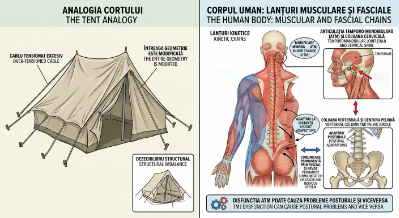
Imagine your body as a tent.
If one of the cables supporting it is excessively tensioned, the entire structure begins to become unbalanced.
It's not just one corner of the tent that's being modified, but its entire geometry.
The human body works the same way.
The jaw, cervical spine, shoulder musculature, and even the pelvic girdle constantly communicate through muscular and fascial chains, coordinated by the nervous system.
That's why a seemingly minor alteration at the TMJ level can lead to distant adaptations, and a postural problem can modify temporomandibular joint function.
What does the scientific literature say?
In recent years, numerous studies have analyzed the relationship between body posture and temporomandibular joint (TMJ) disorders.
Journal of Oral Rehabilitation in a study showing that there is an association between temporomandibular dysfunctions and cervical posture changes, especially head forward postureforward head postureHowever, the authors emphasize that this relationship is complex and that not every postural change is caused by the TMJ or vice versa.
In turn, American Academy of Orofacial Pain It is recommended that the evaluation of patients with temporomandibular disorders include examination of the musculoskeletal system and the cervical spine, as these can contribute to symptomatology.
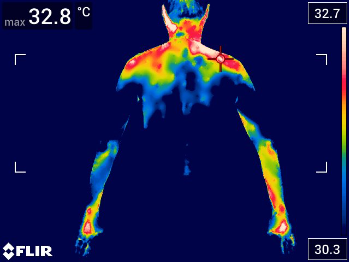
Furthermore, international criteria DC/TMD (Diagnostic Criteria for Temporomandibular Disorders) recommends examining the musculature and associated structures, precisely because TMJ pain and dysfunction cannot be interpreted solely through the lens of the joint.
Therefore, current literature does not support the idea that „all posture problems come from the TMJ” or that „all TMJ dysfunctions are caused by the spine.” Instead, it supports the existence of a functional relationship that must be evaluated individually.
Ascending or descending problems?
An important concept in functional medicine is that of imbalances ascendant and descendant.
Sometimes, the problem starts at the stomatognathic system level. Traumatic occlusion, severe bruxism, or TMJ dysfunction can alter the activity of the cervical musculature and head posture.
In other situations, the mechanism is reversed. Poor posture, reduced cervical spine mobility, or muscular imbalance can influence the jaw position and how the temporomandibular joint functions.
Therefore, the correct question is not „what came first?”, but What is the dominant mechanism in each patient's case?
How do we evaluate this relationship at Innovation Medical Center?
The Innovation Medical Center, ATM evaluation is not limited to articulation.
The analysis begins with a clinical examination of the masticatory muscles, mandibular mobility, and cervical spine, continuing with an assessment of the relationship between occlusion, muscle function, and posture.
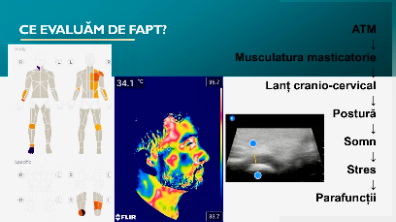
Depending on each case, this can be completed by:
- Medical thermography, to identify muscular imbalances and inflammatory changes;
- Dynamic TMJ ultrasound, which allows real-time evaluation of the joint and periarticular structures;
- digital analysis of bite force, useful in identifying occlusal imbalances and traumatic occlusion;
- 3D intraoral scanning, for the analysis of occlusal relationships and treatment planning;
- CBCT or MRI, when there is a clinical indication.
The goal of these investigations is not to accumulate images, but to understand how all this information connects.
When is a postural assessment necessary?
In certain situations, the analysis must extend beyond the stomatognathic system.
Through the collaboration of Innovation Medical Center and Expert Laser Center, patients can benefit from complex functional assessments and medical rehabilitation programs dedicated to postural imbalances.
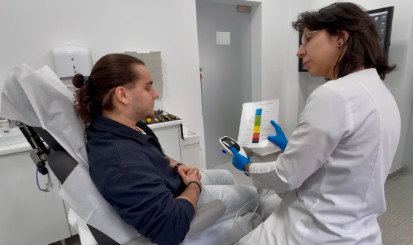
This collaboration is particularly useful when there is persistent neck pain, postural asymmetries, functional limitations, or suspicion that the pain mechanism extends beyond the TMJ area.
The treatment doesn't just target the joint
Depending on the identified mechanism, treatment may include high-intensity laser therapy (LLLT), muscle rebalancing, custom splints, physical therapy, laser acupuncture, or therapeutic exercises.
The goal is not just pain reduction, but restoring the function of the entire system.
Frequently Asked Questions
No. Posture is only one of the factors that can influence joint function.
Not always. The treatment depends on the dominant cause and must be individualized.
Because, in certain cases, cervical musculature and posture contribute to the maintenance of pain and must be addressed together.
The body does not work in compartments.
The temporomandibular joint, cervical spine, musculature, and posture are parts of the same system, in constant communication.
For this reason, a modern evaluation of TMJ disorders means more than examining a single joint. It means understanding the relationships between structures that work together and identifying the mechanism that generates the symptoms.
Expertise and international standards
Innovation Medical Center this associated center and European partner of Sigmund Freud University Vienna and al AALZ Aachen (Germany), being affiliated ISLD (International Society for Laser Dentistry). These academic collaborations guarantee the application of clinical protocols aligned with the highest international scientific standards in laser dentistry and complex therapy. The center utilizes medical infrastructure meeting 2026 standards and boasts a specialized medical team for functional assessment and integrated treatment.
THOR Laser treatment systems are used in the clinical and research activities of prestigious international academic and medical institutions such as Harvard Medical School, Massachusetts Institute of Technology (MIT), University of Pennsylvania, and New York University., alongside military organizations from the US and Great Britain, Olympic teams, elite athletes, and leading medical centers worldwide.
These academic collaborations allow for the implementation of clinical protocols aligned with current international standards in functional diagnostics and laser therapy, based on scientific literature and the principles of evidence-based medicine.
Schedule an evaluation at a center specializing in laser therapies and integrated medicine.
📍 Innovation Medical Center
Bucharest – www.innovationmedical.ro
📞 0753 666 111
Author: Dr. Anca Adam – Specialist Physician in Physical Medicine and Rehabilitation, with a focus on neurological rehabilitation and TMJ/ATM dysfunction, Expert in Laser Acupuncture, Competence in Traditional Chinese Medicine (Tai Yuan, China), Medical Thermography (Barcelona, Spain), LSO (Laser Safety Officer) AALZ Aachen, Germany.




















 Romanian
  English