Tinnitus (ringing in the ears) is not a disease in itself, but a signal that somewhere along auditory–neurologic–muscular–articular chain A dysfunction has appeared. For some patients, it is just a mildly annoying symptom, but for others, it can become a severe problem with a major impact on their quality of life.
Innovation Medical Center is the ATM Therapy Center, with digital technology at the 2026 level, a leader in Romania in minimally invasive laser treatments, with a medical team specialized in ATM treatments. Innovation Medical Center is an associated center and European partner of Sigmund Freud University Vienna and AALZ Germany, being affiliated with ISLD, which guarantees clinical practices aligned with international academic and scientific standards in laser dentistry and ATM therapy.
Medical perspectives on tinnitus:
Otolaryngology Perspective This is often the first stop. Causes include hearing loss (including „hidden” hearing loss), acoustic trauma, ear infections, or Meniere's disease.
Neurological Perspective: Tinnitus is seen as pathological activation of neuronal networks. When there's a lack of auditory signal, the brain tries to „fill the gap,” leading to maladaptive plasticity and increased „background noise.”.
Psychological Perspective: The brain can amplify tinnitus through hypervigilance and anxiety, creating a vicious cycle: sound → stress → tension → louder sound.
Somatosensory Perspective (TMJ and Spine) Tinnitus can be modulated by cervical tensions (C1-C3), trigger points in the SCM or trapezius muscles, and most importantly, by temporomandibular joint dysfunction.
Specific ATM connection: The temporomandibular joint (TMJ) is located in close proximity to the structures of the ear. Studies show that the prevalence of tinnitus in patients with TMD is approximately 30%%. In this case, faulty muscle or joint input „enters” the auditory circuit, and the brain interprets it as sound. This is TMJ-related tinnitus, or somatic tinnitus.
Identifying the correct type of tinnitus (auditory vs. somatosensory vs. mixed) is the essential first step for a treatment that is not just "an explanation," but a real direction for resolution.
In modern practice, TMD-related tinnitus is not treated “by ear.” It is treated according to:
structure
function
neuromuscular control
Postural rebalancing
Peripheral (muscular) and central neuromodulation (by reducing nociceptive input)
The Innovation Medical Center the approach to Tinnitus + TMJ dysfunction Always start with multiple investigations because tinnitus can be a “tip of the iceberg” symptom.
Step 1: Complete ATM + stomatognathic system evaluation
Our protocol includes functional investigations that can highlight causes that a standard consultation might miss:
1) Facial thermography (masticatory muscles) + axial thermography (posture)
identify muscular activation asymmetries
highlighting overexertion on compensatory chains
can show the “signature” of active bruxism or a maintained TMJ dysfunction
2) Left-right bite force analysis
check for real functional imbalance
Highlight hypofunctions/hyperfunctions on a hemirest
correlates with mandibular deviation and unilateral muscular hyperactivity
3) Intraoral scan and functional occlusal evaluation
check for “instability” in occlusal contacts
document the stomatognathic architecture objectively
Assist with planning (including for custom orthotics)
These investigations allow us to determine if the tinnitus is:
auditory cortex
mixed (auditory + somatosensory)
predominant ATM / cervico-mandibular
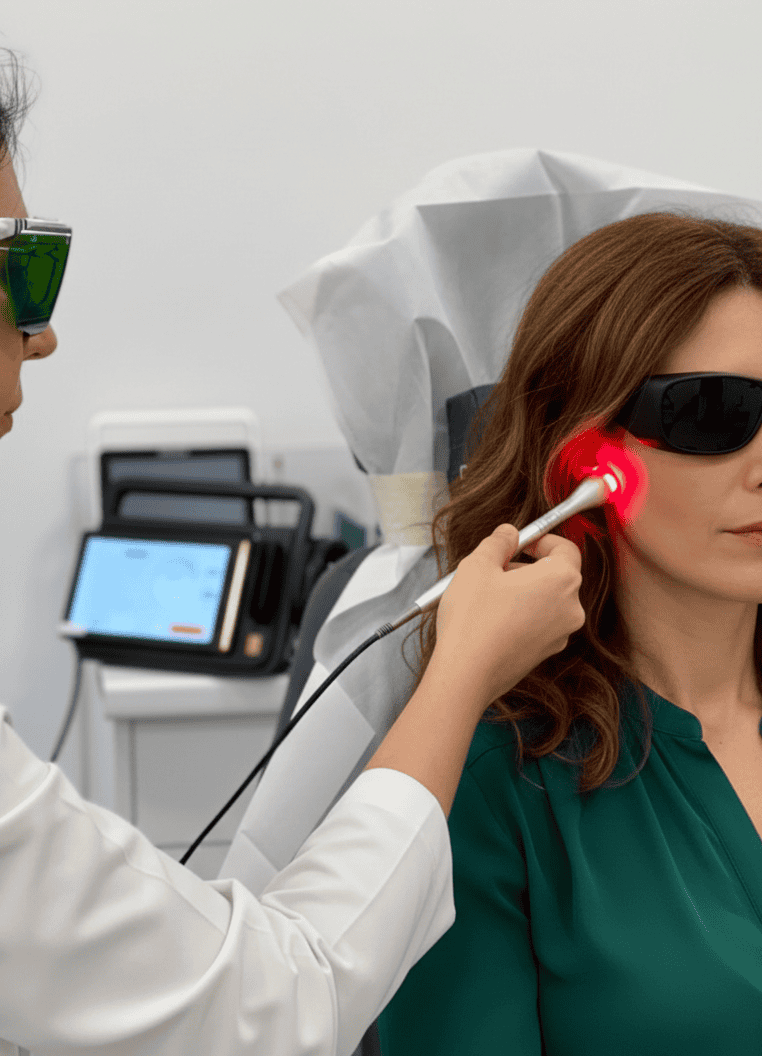
Step 2: Guided laser therapy + laser acupuncture (on the dominant cause)
In 2026, the major advantage is that we can work in a targeted, differentiated manner on the actual components of ATM tinnitus:
1) Muscular and fascial component (masticatory + cervical)
The laser acts on:
trigger points
Myofascial tension
chronic contracture
insertional inflammation
Desired outcome:
✅ SCănociceptive input
✅ jaw relaxation
✅ reduction “somatosensory feedback” care îenterțtinnitus
2) TMJ articular component
On the joint we are following:
Reducing local inflammation
pain-free mobility growth
Condyle-disc biomechanics normalization
3) Neurological Component (tinnitus as an active circuit)
In tinnitus, we treat not only the muscle, but also its effect on the nervous system:
reducing peripheral hyperexcitability
reduction of “false” signals entering the auditory system
Autonomous balancing (stress–sleep–tension)
4) Integrated laser acupuncture
Laser acupuncture is useful when the patient has:
Tinnitus aggravated by stress
Hyperactive vegetative state
Muscle contracture
nocturnal bruxism
anxiety associated
This is a modern, gentle neuromodulation strategy, well-tolerated, especially in patients who do not want needles or have increased sensitivity.
Step 3: Functional stabilization and relapse prevention
After reducing the symptom, our goal is for the tinnitus not to “return.”.
Here enters:
Functional ATM rebalancing
Bruxism control (awareness)
Cervical-mandibular posture recommendations
Functional occlusal support (when applicable)
FAQs – Frequently Asked Questions about Tinnitus and TMJ
Yes, in some patients, tinnitus is predominant somatosensory (TMJ/cervical). Studies show significant associations between TMJ dysfunction and tinnitus.Taylor & Francis Online).
This is a very suggestive sign. There are clear descriptions of tinnitus modifiable by mandibular/cervical movements through somatosensory-auditory interactions (PubMed).
Yes. Bruxism overloads the masseter and pterygoid muscles, the TMJ, and can accentuate somatic input to the auditory system.
Besides ENT and audiogram, the following are useful:
evaluate functional clinical ATM
Facial and axial (postural) thermography
Left-right bite force analysis
intraoral scan
TMJ ultrasound
sometimes MRI TMJ / MRI brain (depending on the case)
Stress can amplify tinnitus, especially through neuro-psychic mechanisms, but most of the time there is also a functional (TMJ/cervical) or auditory substrate that is worth investigating.
In conditions where the cause is muscular/articular (TMJ) and there is a somatosensory component, laser therapy can be a very valuable method for:
pain and tension relief
reducing inflammation
peripheral neuromodulation
It depends on the age and severity. In many cases, it's done in stages:
early anti-inflammatory/relaxation phase
functional stabilization phase
prevention phase (occlusion, posture, bruxism)
Sometimes yes, other times it can be significantly reduced in intensity and impact. The key is identifying the correct type: auditory vs. somatosensory vs. mixed.
Conclusion: tinnitus is not treated “randomly” - it is investigated and treated based on its cause
Tinnitus is a complex symptom, and behind it there can be:
An ENT cause
a neurological component, of neuroplasticity
ATM/cervical dysfunction with somatosensory impact
an emotional amplification that sustains the symptom
When tinnitus is related to TMJ dysfunction full is a complete protocol: Functional diagnostics + stomatognathic balancing + muscle relaxation + guided laser therapy + neuromodulation (including laser acupuncture).
The Innovation Medical Center Bucharest our approach to Tinnitus of TMJ origin always start with objective investigations and proceed with targeted, modern, and multidisciplinary treatment so that the patient receives not just “an explanation,” but a real direction for resolution.
Schedule a comprehensive evaluation
📍 Bucharest www.innovationmedical.ro
📞 0753 666 111
Author: Dr. Anca Adam, Specialist Physician in Physical Medicine and Rehabilitation, specializing in neurological recovery and TMJ/TMD dysfunctions, Expert in Laser Acupuncture & Certified in Traditional Chinese Medicine (Tai Yuan, China), Medical Thermography (Barcelona, Spain) – LSO (Laser Safety Officer) AALZ Aachen, Germany.