Jaw, head, or neck pain is often treated as an isolated symptom. In reality, the temporomandibular joint (TMJ) functions as a extremely complex issue The jaw has a connection to the teeth, muscles, cervical spine, and nervous system. When this „hinge” no longer works in sync, signals appear that the body transmits in various ways.
A consultation Medical Specialist ATM often begins with a detailed discussion about the history of the pain, and What you observe, as a patient, is essential for a correct diagnosis.
History of pain: when and how does the discomfort appear?
An important first step is to write down the onset of pain. Does it appear in the morning, immediately after waking up, or especially after eating? There's an important difference.
Morning pain may indicate that the joint has been overused during the night, similar to what happens when a door is repeatedly forced into the wrong position. Pain that occurs when chewing, on the other hand, suggests an imbalance in the way the jaw moves or closes.
Equally relevant are the sensations of deadlock, „clicks” or a deviation of the jaw when opening the mouth. These are signs that the joint is no longer moving smoothly, but rather with „interruptions,” much like a mechanism that needs adjusting.
Secondary symptoms that may be related to TMJ
Many patients are surprised to learn that dizziness, ringing in the ears, or neck pain may be related to the jaw joint. The TMJ is positioned extremely close to the inner ear and important nerve structures, and imbalances can „radiate” symptoms to distant locations.
If you have:
vertigo or a feeling of unsteadiness (dizziness),
tinnitus (ringing in the ears), a feeling of ear congestion,
ear pain without an ENT cause,
persistent neck or shoulder pain,
It is important to mention these details during your consultation with the TMJ specialist; this information is all part of the same picture.
Older medical records: why they’re worth bringing to your appointment
Previous panoramic radiographs or CT scans are not useless, even if they did not lead to a clear diagnosis. They can offer a structural context like an old map that, when combined with modern technology, helps provide more accurate navigation.
If you have any such test results, we recommend that you bring them with you. Even though modern treatment emphasizes functional assessment, static imaging remains an important part of a comprehensive evaluation of your progress.
Why TMJ treatment will be multidisciplinary by 2026
In 2026, Innovation Medical Center differentiates itself in the Romanian medical market through an approach integrated and truly multidisciplinary of temporomandibular joint disorders. Assessment and treatment are not fragmented across specialties or separate stages, but are coordinated in a unified manner, within the same center, by teams that include a TMJ specialist, a dentist, a physical medicine and rehabilitation physician, an oral and maxillofacial surgeon, and an ENT specialist. This approach allows for the precise integration of functional investigations, laser therapy based on scientifically validated technologies, the use of custom-made dental appliances, and neuromuscular and postural rehabilitation. For the patient, this means a a coherent, individually tailored treatment plan, a short time to an accurate diagnosis, and predictable outcomes, within a treatment model aligned with current international standards.
At specialized centers such as Innovation Medical Center, each case is analyzed holistically so that treatment is not limited to pain relief, but rather to addressing the underlying cause.
The Thor Laser and Modern Treatments for TMJ Disorder
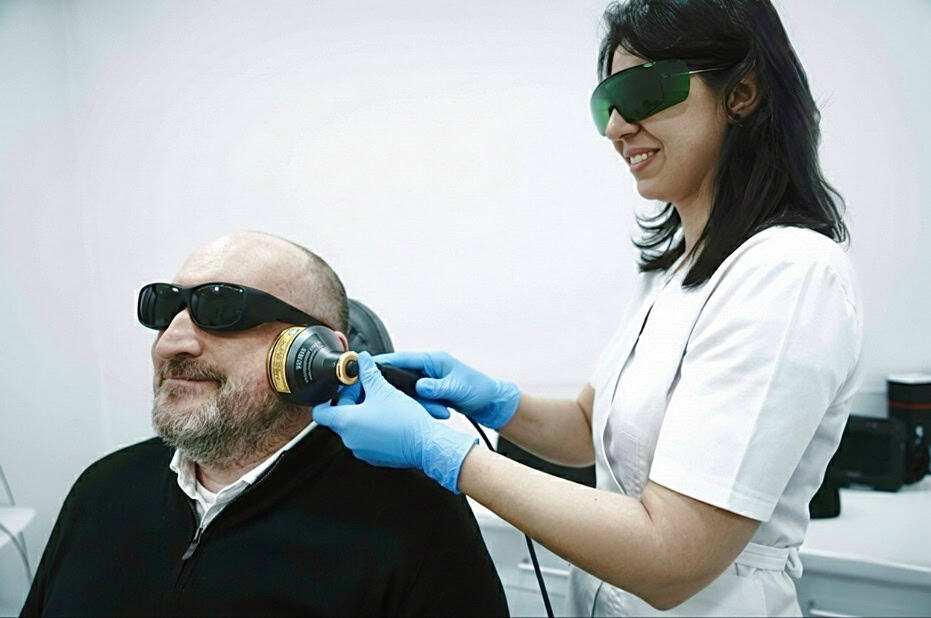
An important component of modern treatment is low-frequency laser therapy created using systems such as Thor medical laser. It is used in protocols based on randomized, placebo-controlled trials, as it is one of the few technologies laser technologies backed by scientific research.
Laser therapy is used to support the body’s natural healing processes without invasive procedures and without disrupting daily activities. Depending on the case, the treatment may be supplemented with dental devices customized such as dental tray sau the splint, individually customized to reduce joint strain and properly guide jaw position.
The connection between the TMJ and posture
The position of the head and neck directly influences the temporomandibular joint. Therefore, in many situations, recovery does not stop at the jaw level. In collaboration with Expert Laser Center postural recovery includes thermographic evaluation AI-assisted and laser therapy, laser acupuncture, electroacupuncture, and manual therapy to restore the balance between the jaw, spine, and the rest of the body.
It's like aligning a car's wheels: if one is out of alignment, the others will compensate, and the problem will re-emerge.
At Expert Laser Center Partnership with AALZ Germany and SFU Vienna, we apply methods minimally invasive for medical rehabilitation, with 2026-level technology, being top 3 in Europe and top 1 in Romania.
FAQ – Frequently Asked Patient Questions
Yes. TMJ dysfunction is a common cause of headaches, especially morning headaches.
Not always. Some gutters or splints are used temporarily as part of treatment.
The laser therapy is painless and well-tolerated by most patients.
Most of the time, evaluation and monitoring are needed because the TMJ is a dynamic joint.
Jaw pain should not be ignored or treated in isolation. With the correct information, an evaluation by a Medical Specialist ATM and a personalized therapeutic plan, temporomandibular joint dysfunctions can be understood and treated effectively.
Schedule a comprehensive evaluation
📍 Bucharest www.innovationmedical.ro
📞 0753 666 111
Author: Dr. Anca Adam, Specialist in Physical Medicine and Rehabilitation, with a specialization in Neurological Rehabilitation and TMJ/ATM Dysfunctions, Laser Acupuncture Expert & Certified in Traditional Chinese Medicine (Tai Yuan, China), Medical Thermography (Barcelona, Spain) – LSO (Laser Safety Officer) AALZ Aachen, Germany