
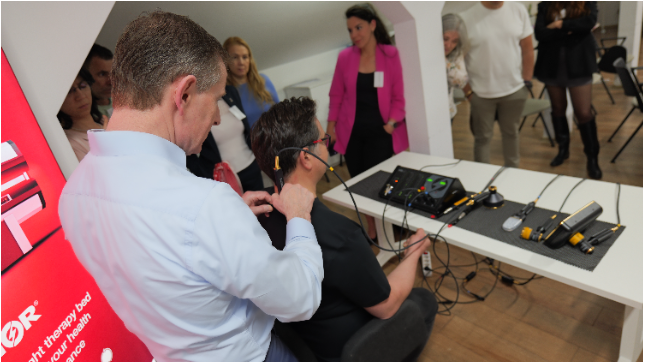
As laser treatments become more widely known, numerous incomplete or misunderstood pieces of information also emerge. Some of these are harmless, but others can prevent patients from benefiting from modern, minimally invasive treatments. Here are some of the most common myths about laser dentistry.
Myth 1: There is only one type of dental laser
False. There are numerous wavelengths and categories of lasers. Diode lasers and erbium lasers function differently and have different indications. In reality, when we talk about Laser dentistry, We are talking about an entire family of technologies, not just a single device.
Myth 2: All lasers do the same thing
False. Some are excellent for disinfection, others for surgery, others for hard tissue treatment, and still others for biostimulation. There's no single laser that's best at everything. Each wavelength has advantages, limitations, and specific indications.
Myth 3: If a cabinet has a laser, the results are automatically better
False. The laser is just a tool. The doctor's experience and understanding of the interaction between the laser and tissue are what influence the final outcome. Two practices can have the exact same machine and achieve completely different results.
Myth 4: Lasers only mean gum surgery
False. Today, the laser is used in:
- endodontics;
- periodontology;
- pedodontics;
- oral surgery;
- implantology;
- cavity treatment;
- Biostimulate;
- disinfection.
The possibilities are much more extensive than most patients imagine.
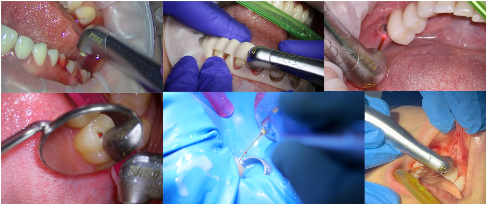
Myth 5: Lasers can only be used on gums.
False. Erbium lasers are absorbed by hydroxyapatite, allowing for treatments on both soft and hard tissues. This is one reason why they can be used in the treatment of cavities, bone surgery, and numerous other dental procedures.
Chapter 6: The Laser is Dangerous
False. When used correctly, lasers are a very safe technology. Like any advanced medical technology, they require knowledge, experience, and adherence to strict safety protocols. Proper eye protection and the use of correct parameters are mandatory.
Chapter 7: The Laser Completely Replaces All Conventional Tools
False. The laser should not be viewed as a universal replacement. Its value emerges when it is intelligently integrated into the treatment plan and used where it offers real benefits to the patient.
Myth 8: All laser treatments are painless
False. Many procedures are more comfortable for the patient and can reduce postoperative discomfort. In certain situations, some procedures may require less anesthesia or none at all. However, pain perception differs from patient to patient and from procedure to procedure.
Myth 9: Lasers are just a marketing tool
False. The laser is one of the most studied and validated technologies in modern dentistry. Its clinical applicability is vast and continues to expand as new research and treatment protocols emerge.
Chapter 10: The device is what performs the treatment
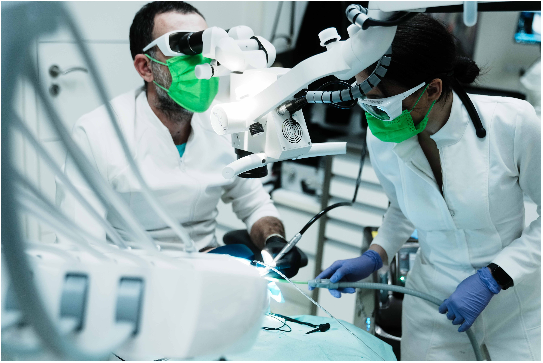
Perhaps this is the most important myth of all. Many patients believe that the result is guaranteed by the mere existence of a certain device. In reality, two practices can have the exact same laser, use the same wavelength and parameters, and the results can be completely different. The technique, experience, and dexterity of the doctor matter enormously. The position of the handpiece, the working speed, the angle of application, the distance from the tissue, and the understanding of how energy is transferred to the tissue directly influence the final outcome. Just like in classical surgery, the instrument is important, but the hand using it is even more important.
Conclusion
Perhaps the biggest myth is that the laser represents the future of dentistry. In reality, the laser is no longer the future, but the present. It is a mature, studied, clinically validated technology used today in numerous.
But the true revolution is not represented by a single technology. The greatest transformation occurs when multiple high-performance technologies are intelligently integrated into a single diagnostic and treatment plan. Today we can combine lasers with digital intraoral scanning, digital treatment planning, medical photography and thermal photography, computerized occlusion analysis, digital periodontal pocket measurement, and many other modern systems that allow for diagnosis and treatment with an accuracy impossible just a few decades ago.
Perhaps the most important idea is that laser dentistry does not mean a single device or a single wavelength. Diode lasers and erbium lasers complement each other and offer different biological effects. When used together, they allow for therapeutic approaches that seemed impossible just a few years ago.
However, as in any medical field, technology alone is not enough. The difference is made by experience, education, understanding of laser physics, and the operator's dexterity. The laser represents one of the most important technological revolutions in modern dentistry, but its true value emerges when it is intelligently integrated alongside other modern technologies and used by a doctor who deeply understands both the technology and the biology of the tissues they treat.
Programă or consultationțI.e. și discoveră How modern laser technologies can transform dental treatments!
📍 Innovation Medical Center
Bucharest
📞 0753 666 111
Authori:
Dr. Thomas Mendel– Medical Director and Dentist at Innovation Medical Center, Co-founder Cluj Smile Society, Laser Dentistry Expert, Master of Science – Laser therapy in dentistry (AALZ Aachen & Sigmund Freud University Vienna), Laser Safety Officer (LSO) – AALZ Aachen, trainer in laser dentistry, with dedicated activity in endodontics, periodontics, minimally invasive approaches, and digital dentistry.
Dr. Nur Saadeddin– Medical dentist within Innovation Medical Center, Co-Founder of Cluj Smile Society, Laser Dentistry Expert, Master of Science – Laser therapy in dentistry (AALZ Aachen & Sigmund Freud University Vienna), Laser Safety Officer (LSO) – AALZ Aachen, trainer in laser therapies, with dedicated activity in prosthetics, periodontology, minimally invasive approaches, and digital dentistry.




















 Romanian
  English