
Most of the time, when a earache the first thought is simple and logical: „I have an infection.” The patient goes to the doctor ENT, investigations are underway, and the result is… normal. And yet, the pain exists. It persists, sometimes for days, sometimes for months.
At that moment, confusion sets in: if it's not the ear, then what is it?
The answer, surprising to many patients, may be right next to the ear— joint temporal-temporomandibular joint (TMJ), the joint that connects the jaw to the skull and that functions every time we speak, chew, or swallow.
lion.
Why can the jaw hurt „like an ear”?
To understand this, we must look at the area not as separate organs, but as a system.
The ear, the temporomandibular joint, and the surrounding muscles are anatomically extremely close and, more importantly, are connected by the same nerves. In particular, the auriculotemporal nerve transmits information from both the joint area and the ear area.
This means that when a problem arises at the TMJ level, the brain can „interpret” the pain as being from the ear.
A simple comparison helps a lot: it's like when an electrical problem in one room makes the light flicker in another. The fault isn't where you see the effect, but that's where you feel it.
What is actually happening in the body?
In temporomandibular joint (TMJ) disorders, pain can arise through several overlapping mechanisms.
On the one hand, Musculature masticatory (especially the masseter and temporalis) can go into contracture, especially in stress context sau bruxism. This constant tension creates painful pressure points that radiate to the ear.
On the other hand, the joint itself can become irritated or inflamed, especially when there is an unstable position of the condyle or repeated overuse.
To these are added the nervous component: pain signals are „projected” to the ear, even if the source is different.
Specialized literature confirms this relationship. Studies published in Journal of Oral & Facial Pain and Headache shows that TMJ disorders are frequently associated with ear pain in the absence of an ENT condition. At the same time, the prevalence of TMJ-related symptoms in the general population is approximately 10–15%.
In other words, it's not a rare situation—it's a frequently unrecognized situation.
How do you know it's not an ear infection?
The difference is not always obvious, but there are a few signs that can guide the diagnosis.
Temporomandibular joint (TMJ) pain often appears in front of the ear and changes with jaw movement. It can be more intense when chewing or opening the mouth and is often accompanied by joint noises, a feeling of facial tension, or morning muscle fatigue.
In contrast, a classic otitis usually has a constant character, may be accompanied by fever or signs of infection, and does not change significantly with jaw movement.
This seemingly subtle difference is, in fact, essential.
Why is this diagnosis often delayed?
Because the pain doesn't appear where the problem is.
Many patients go through multiple consultations — ENT, neurology, sometimes even dentistry — without receiving a clear answer. Not because the problem doesn't exist, but because it's not viewed holistically.
We must take into account that not all ear pain is from the ear. This simple idea completely changes the way we assess it.
How is the correct diagnosis established?
Diagnosing TMJ dysfunction is not based on a single investigation, but on correlating multiple elements.
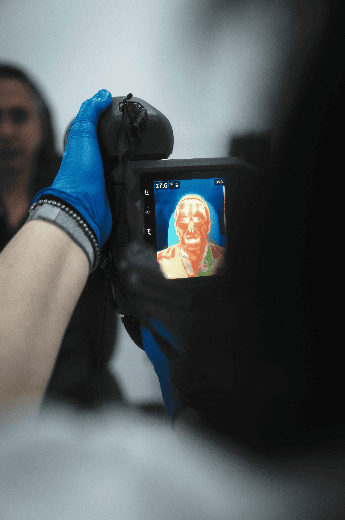
The evaluation includes examining jaw movements, palpating the musculature, analyzing symptoms, and, above all, investigations functional imagistic Orient correctly.
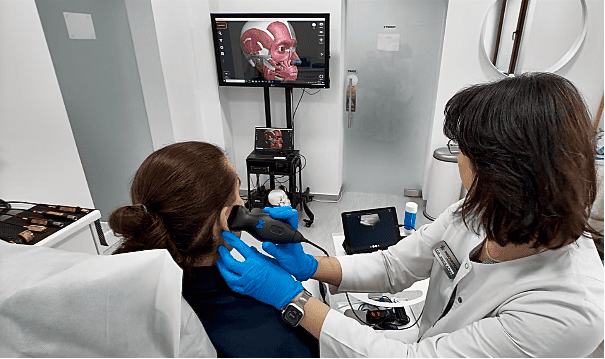
The Innovation Medical Center, this evaluation is extended to a comprehensive functional analysis that takes into account not only joint, as well as Musculature, occlusion and the relationship with Posture and The nervous system.
The approach is supported by European academic collaborations and the use of modern assessment technologies, which allows for a more accurate understanding of each patient's individual mechanism. Innovation Medical Center is an associated center and European partner of Sigmund Freud University Vienna and AALZ Germany, affiliated with ISLD (International Society for Laser Dentistry). These academic collaborations ensure the application of clinical protocols aligned with the highest international scientific standards in laser dentistry and complex therapy. The center utilizes medical infrastructure meeting 2026 standards and boasts a specialized medical team in functional evaluation and integrated treatment.
What treatment options are available?
The treatment is not standard and should not be identical for all patients.
Depending on the cause, this may include muscle relaxation, control of parafunctions (such as bruxism), joint stabilization with custom splints, and therapies with anti-inflammatory and myofascial/neuromuscular rebalancing roles for the masticatory and postural muscles.
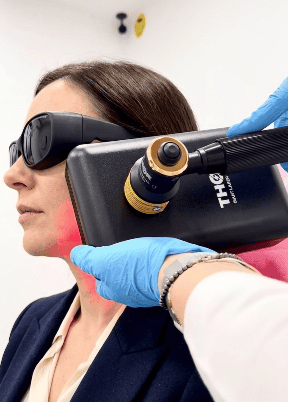
LLLT laser therapy is one of the modern methods used in this context. Randomized placebo-controlled studies have demonstrated significant effects in reducing pain and Improving muscle function in TMD.
What is important, however, is not just the treatment itself, but choosing the correct one based on the dominant mechanism.

How do patients describe this problem?
Patients don't use medical terms, but their descriptions are extremely suggestive.
„I feel pressure in my ear, but my tests are good.”
„It hurts when I chew, but also when I'm still. My ear is plugged as if I were in a barrel.”
„The pain comes and goes and I don't understand why.”
These phrases appear frequently and, often, they are the first indicators that the source is not the ear itself.
Frequently Asked Questions (FAQ)
Yes, it's one of the most common non-ENT causes of ear pain.
An important clue is whether the pain changes with jaw movement or is associated with muscle tension.
For the TMJ, investigations should be directed towards the joint and its function.
I can temporarily reduce the pain, but it doesn't treat the cause.
In most cases, symptoms can be effectively managed with a correct and personalized approach.
Ear pain without otitis is not a mystery, nor is it a rare exception. It is, in fact, a frequent situation in which the body transmits a signal from one area, but we feel it in another.
In these cases, the key is not to just treat the site of pain, but to understand where the problem originates. Because sometimes, the ear is just the messenger.
Schedule an assessment at a center specializing in laser therapies and integrated medicine!
Innovation Medical Center
📍 Bucharest – www.innovationmedical.ro
📞 0753 666 111
Autor: Dr. Anca Adam, Medic Specialist in Medicina Fizica si de Reabilitare, compartiment recuperare neurologică și disfuncții ATM/TMJ, Expert Acupunctură Laser & Competenta Medicina Traditionala Chineza (Tai Yuan, China), Termografie Medicală (Barcelona, Spania), LSO (Laser Safety Officer) AALZ Aachen Germania.




















 Romanian
  English