
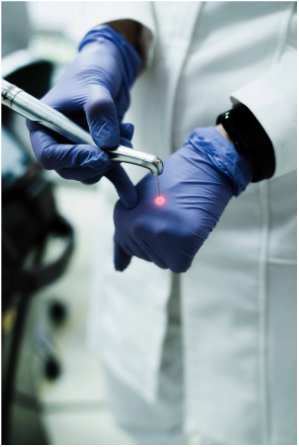
The main goal of endodontic treatment is the elimination of infection from the root canal system, from the dentin, and the creation of conditions necessary for the healing of the tissues surrounding the tooth.
Although mechanical instruments and irrigation solutions remain important and the most used elements of endodontic treatment, the complex anatomy of the canal system makes direct access impossible in all areas where bacteria may exist.
For this reason, we use several types of lasers, each having a specific role in the decontamination and healing process.
Why is itâIt's difficultă bacterial elimination
Root canals are not simple straight tubes.
They contain numerous branches, side channels, and microscopic irregularities.
In these areas, bacteria form organized structures called biofilms.
Biofilm represents a community of bacteria protected by its own matrix, which allows them to adhere to surfaces and resist external factors more effectively.
In endodontics and periodontology, biofilm is one of the most important causes of persistent infections.
What is the smear layer?
During mechanical instrumentation of canals, a microscopic layer of organic and inorganic debris appears.
This is called the smear layer.
The smear layer contains bacteria and can cover the opening of dentinal tubules, limiting the effectiveness of disinfection and subsequent sealing.
For this reason, its elimination is considered a very important objective of endodontic treatment.
The role of 2780 nm and 2940 nm Erbium lasers
Erbium lasers are absorbed very efficiently by water.
When laser energy interacts with water molecules, a phenomenon called thermo-mechanical ablation occurs.
In layman's terms, the water vaporizes very rapidly (explosively) and produces a shock wave that helps to remove remaining tissues, clear and fragment biofilm, and other microscopic deposits from the canal surface.
These wavelengths are used for:
- removal of residual tissues from the canal;
- removal of the smear layer;
- biofilm fragmentation;
- lateral channel cleaning;
- reduction of bacterial load.
An important advantage is that these lasers are absorbed by water, which allows them to act effectively even on microorganisms that do not contain significant amounts of bacterial pigments.
What is cavitation?
During laser activation, microbubbles appear, forming and collapsing very rapidly.
This phenomenon is called cavitation.
Cavitation contributes to biofilm fragmentation and the mobilization of debris from areas that cannot be directly reached by endodontic instruments.
Another important effect is the generation of a fluid flow that favors the displacement of debris towards the coronal area and its evacuation from the canal system.
The role of the 450 nm laser
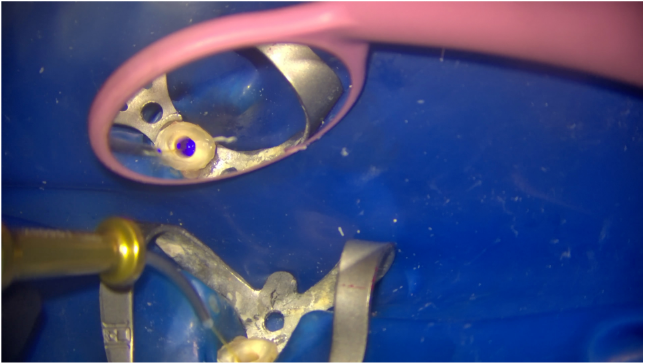
The 450 nm laser is mainly used for disinfection.
This wavelength is absorbed by pigments such as melanin and hemoglobin.
Melanin is present in the structure of certain bacteria, which allows for an effective antimicrobial effect.
The role of the 810 nm laser
The 810 nm laser has a high penetration capacity into dental tissues (several centimeters through dentin).
This allows for deep disinfection, beyond what can be achieved solely through mechanical instrumentation and irrigation with solutions such as sodium hypochlorite, EDTA, or citric acid.
In addition to the antimicrobial effect, these wavelengths are also used for photobiomodulation.
What is photobiomodulation?
Photobiomodulation represents the use of light energy to stimulate the body's natural biological processes.
Numerous studies have shown that light energy can influence cellular activity and tissue metabolism.
The purpose of using photobiomodulation is to support natural healing processes.
Among the sought-after effects are:
- stimulation of cellular activity;
- increased ATP production, the cell's main energy source;
- improving microcirculation;
- neovascularization stimulation;
- improving lymphatic drainage;
- reduction of postoperative symptomatology.
Does laser replace traditional endodontic treatment?
No.
The laser does not replace mechanical instrumentation, irrigation, or canal obturation.
It represents a complementary technology that greatly enhances the decontamination and disinfection of the endodontic system and creates the necessary conditions for healing.
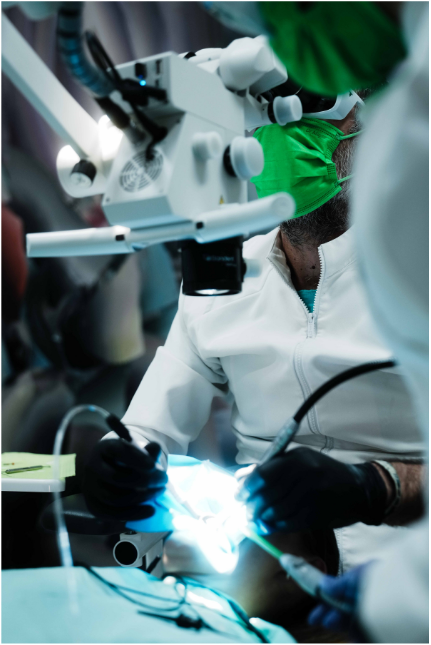
In our practice, the laser is integrated into a protocol that includes treatment under a microscope, isolation, and mechanical instrumentation of the root canals.
Why do we use multiple wavelengths?
No wavelength can do it all.
Each type of laser has different characteristics and interacts differently with tissues and microorganisms.
Through the combined use of erbium lasers, the 450 nm laser, and the 810 nm laser, we aim to leverage the advantages of each individual wavelength to achieve a synergistic effect.
The ultimate objective remains the same: reducing bacterial load, eliminating biofilm, and creating the most favorable conditions for the natural tooth to heal and be preserved.
Schedule a consultation and discover how modern laser technologies can transform dental treatments!
📍 Innovation Medical Center
Bucharest
📞 0753 666 111
Authori:
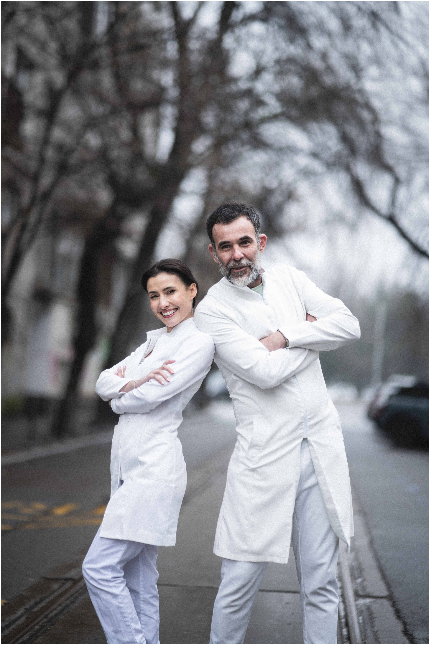
Dr. Thomas Mendel– Medical Director and Dentist at Innovation Medical Center, Co-founder Cluj Smile Society, Expert in Laser dentistry, Master of Science – Laser therapy in dentistry (AALZ Aachen & Sigmund Freud University Vienna), Laser Safety Officer (LSO) – AALZ Aachen, trainer in laser dentistry, with dedicated activity in endodontics, periodontics, minimally invasive approaches, and digital dentistry.
Dr. Nur Saadeddin– Medical dentist within Innovation Medical Center, Co-Founder of Cluj Smile Society, Laser Dentistry Expert, Master of Science – Laser therapy in dentistry (AALZ Aachen & Sigmund Freud University Vienna), Laser Safety Officer (LSO) – AALZ Aachen, trainer in laser therapies, with dedicated activity in prosthetics, periodontology, minimally invasive approaches, and digital dentistry.





























 Romanian
  English