
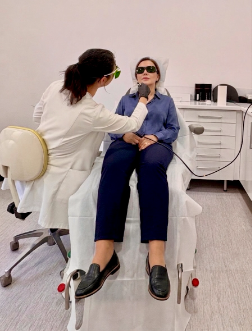
The first consultation begins with understanding the patient.
Most patients who come to Innovation Medical Center I am not saying it is temporomandibular joint pain. They describe seemingly unrelated symptoms: earaches without infection, migraines, jaw noises, neck pain, difficulty chewing, or even dizziness.
This is why, before any treatment, the most important step is establishing a correct diagnosis.
International literature and criteria DC/TMD (Diagnostic Criteria for Temporomandibular Disorders) Consider the medical history and physical examination as the basis for diagnosis, with imaging investigations recommended only when clinically justified.
Everything starts with a discussion
The first part of the consultation is dedicated to the medical history.
We are interested not only in where it hurts, but also when the symptoms appeared, if there are joint noises/clicks, jaw locking, traumas, orthodontic treatments, previous splints/mouthguards, bruxism episodes, sleep disorders, stress, or other conditions in the neurological, ENT, and rheumatological spheres only.
Often, this discussion provides essential clues that cannot be observed in any imaging investigation.
Functional clinical examination
The consultation continues with a comprehensive evaluation of the temporomandibular joint and the stomatognathic system.
The mobility of the mandible, joint noises, masticatory muscles, sensitivity of painful points, the relationship between the mandible and the cervical spine, and the patient's posture are analyzed.
For us, the jaw is not an isolated structure, but part of a complex functional system.
When are further investigations necessary?
Depending on each case, the evaluation can be completed with modern technologies available within Innovation Medical Center.
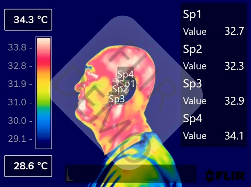
Medical thermography allows highlighting muscle imbalances and areas with increased metabolic activity.
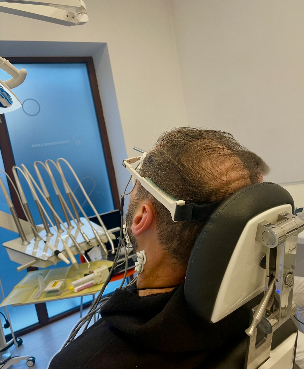
Digital analysis of bite force Identify the distribution of occlusal pressures and any functional imbalances.
3D digital scanning of dentition, made with a state-of-the-art intraoral scanner, allows for precise evaluation of dental arches and occlusal relationships. Together with clinical and functional analysis, this contributes to the identification of occlusal imbalances and traumatic occlusion that can influence TMJ function.
Dynamic TMJ Ultrasound provides real-time information about joint movement and periarticular structures.
When indicated, investigations such as X-rays, CBCT, or MRI can also be recommended, but these complement the clinical examination, without replacing it.
A personalized treatment plan
After completing the evaluation, all information is integrated to build a Therapeutic plan multidisciplinary tailored to each patient.
Depending on the diagnosis, this may include high-intensity laser therapy (LLLT), custom splints, physical therapy, muscle rebalancing, laser acupuncture, or interdisciplinary collaborations.
There are no two identical TMJ dysfunctions, and for this reason, there are no two identical treatments.
An integrated approach
A distinguishing element of the approach Innovation Medical Center this close collaboration with Expert Laser Center, where patients can benefit, when necessary, from postural assessments and complex medical rehabilitation programs.
In many situations, TMJ imbalances are influenced by ascending or descending postural changes, which is why evaluating the entire functional chain can play an essential role in achieving stable long-term results.
Academic expertise and collaborations
Innovation Medical Center this associated center and European partner of Sigmund Freud University Vienna and al AALZ Germany, being affiliated ISLD (International Society for Laser Dentistry). These academic collaborations guarantee the application of clinical protocols aligned with the highest international scientific standards in laser dentistry and complex therapy. The center utilizes medical infrastructure meeting 2026 standards and boasts a specialized medical team for functional assessment and integrated treatment.
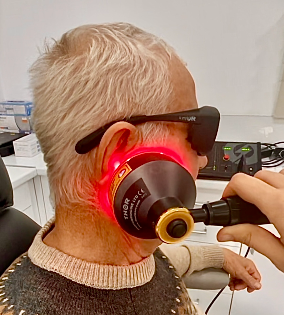
THOR Laser treatment systems are used in the clinical and research activities of prestigious international academic and medical institutions such as Harvard Medical School, Massachusetts Institute of Technology (MIT), University of Pennsylvania, and New York University., alongside military organizations from the US and Great Britain, Olympic teams, elite athletes, and leading medical centers worldwide.
These academic collaborations allow for the implementation of clinical protocols aligned with current international standards in functional diagnostics and laser therapy, based on scientific literature and the principles of evidence-based medicine.
Frequently Asked Questions
Not necessarily. If you have previous investigations, it is recommended that you bring them, but the need for further examinations will only be determined after the consultation.
The purpose of the first visit is to establish a diagnosis and treatment plan. In certain situations, treatment may begin on the same day.
Yes. It is useful to bring all previously used gutters, as they provide important information about treatment history.
A modern consultation for TMJ dysfunction means more than just evaluating a joint. It means understanding how the entire stomatognathic system functions, its relationship with posture, musculature, and the nervous system, and choosing a treatment based on an accurate diagnosis.
Schedule an evaluation at a center specializing in laser therapies and integrated medicine.
📍 Innovation Medical Center
Bucharest – www.innovationmedical.ro
📞 0753 666 111
Author: Dr. Anca Adam – Specialist Physician in Physical Medicine and Rehabilitation, with a focus on neurological rehabilitation and TMJ/ATM dysfunction, Expert in Laser Acupuncture, Competence in Traditional Chinese Medicine (Tai Yuan, China), Medical Thermography (Barcelona, Spain), LSO (Laser Safety Officer) AALZ Aachen, Germany.




















 Romanian
  English