
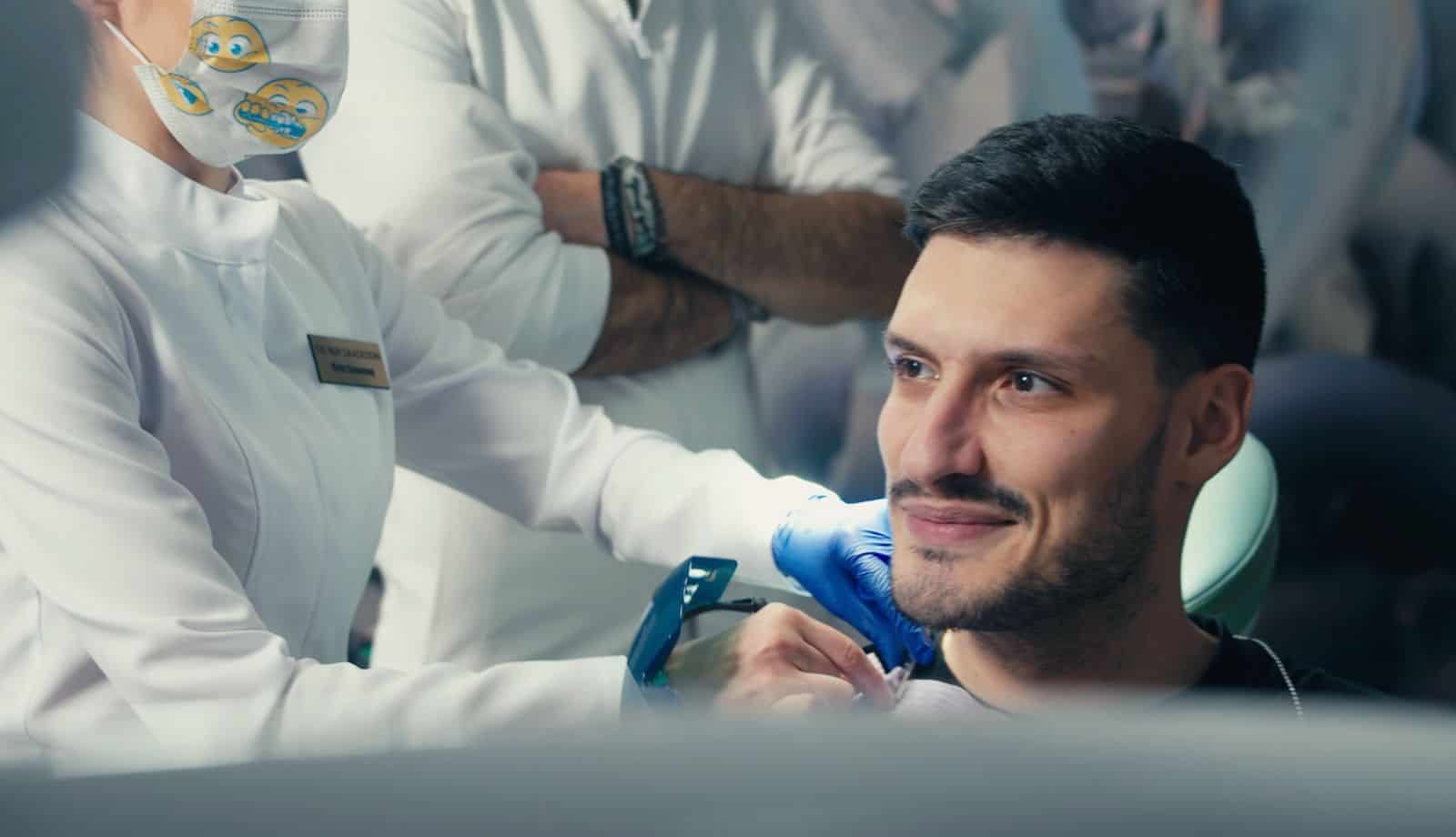
What is periodontal disease?
Periodontal disease, popularly known as „pyorrhea,” is a chronic infection of the tissues that support the tooth: the gum, the periodontal ligament, and the alveolar bone. It occurs when bacterial plaque and tartar cause inflammation, leading to bone loss, gum recession, tooth mobility, and, in advanced stages, tooth loss.
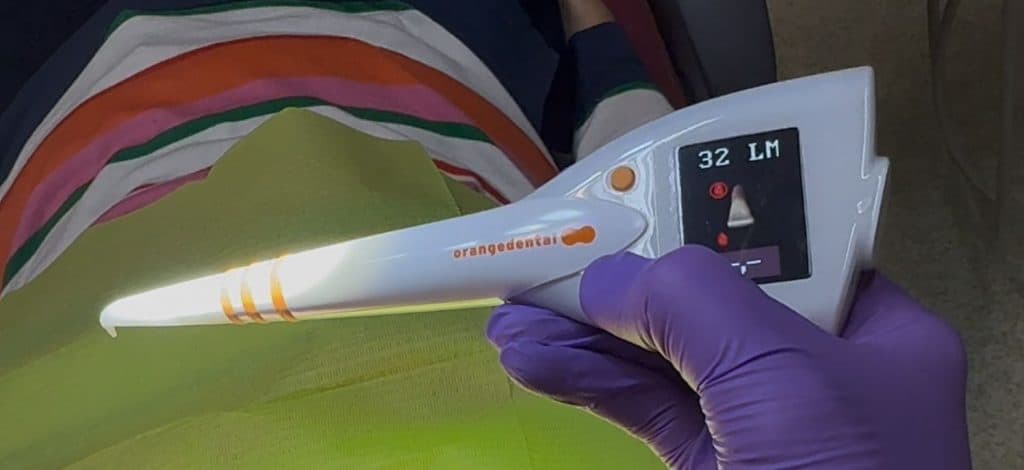
It is a progressive condition that cannot be cured, but its progression can be stopped. Periodontal disease This is a complex condition, and its treatment requires a precise approach. In our clinic, we use two laser wavelengths: the diode laser for disinfection and the Erbium, Chromium:YSGG laser for debridement and removal of granulation tissue. This method allows for deep cleaning of periodontal pockets without the complications of classic surgical techniques.
Innovation Medical Center offers TMJ treatments and laser dentistry for laser periodontics, with technology at the 2026 level, making it a leader in Romania in laser dentistry. Innovation Medical Center is an associated center and European partner of Sigmund Freud University Vienna and AALZ Germany, being affiliated with ISLD, which guarantees clinical practices aligned with international academic and scientific standards in laser dentistry and TMJ therapy.
1. Initial Assessment - Digital Periodontal Chart
Before starting treatment, we perform a complete periodontal charting using a digital probe, which shows us the exact depth of each periodontal pocket. This step is essential for having an objective baseline and for being able to track the progress and effectiveness of the treatment over time.
2. Why laser and not flap?
The classical technique involves creating a flap, during which the bone remains temporarily avascular, resulting in approximately 0.5 mm of bone resorption simply from the flap being opened. Reattaching the tissue to the bone and revascularization after the flap takes up to 6 weeks.
With laser treatment, we avoid this step and preserve tissue integrity.
3. Diode laser disinfection
The actual treatment begins with the laser. diode, used for remote disinfection. Bacteria absorb energy emitted by the laser due to the melanin in the epithelium. This allows for deep, controlled, and selective decontamination.
4. Airflow EMS
AirFlow is a prophylaxis procedure that uses a controlled jet of pressurized air, water, and a fine powder of 14 µm or 40 µm to effectively remove bacterial plaque, stains, and biofilm from the tooth surface and hard-to-reach areas. It is a gentle, minimally invasive method, which leaves the teeth clean and smooth, without affecting enamel or gums.
5. Deep scaling
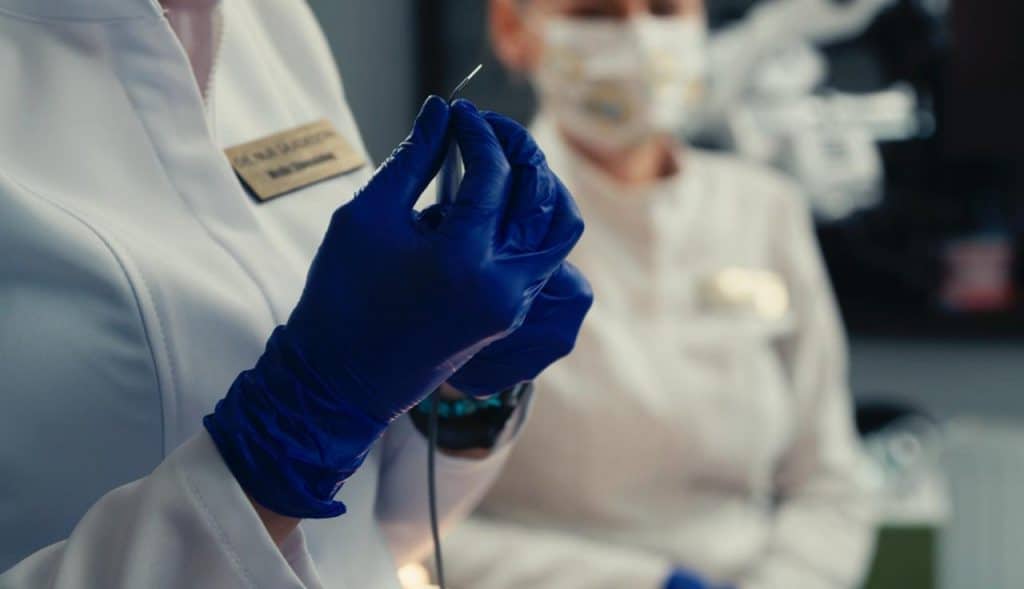
Next descaling deep, made with a special loop designed for removing tartar from hard-to-reach areas. Ultrasonic scaling is a professional dental procedure that uses ultrasonic vibrations to effectively remove tartar, plaque, and subgingival deposits. The water jet associated with the vibrations cools the teeth and removes debris, leaving the tooth surface clean, smooth, and less prone to future plaque accumulation.
6. Debridement and Biofilm Disruption with the Erbium, Chromium:YSGG Laser
Next, we introduce the Erbium, Chromium:YSGG laser, used for:
Unblock,
biofilm disruption,
granulation tissue removal,
removal of tartar residue through negative pressure exerted inside the bag.
This wavelength is efficiently absorbed by hydroxyapatite and the OH groups in water, giving it a strong bactericidal effect. Affected gingival tissue is precisely removed without additional trauma.
7. Application of adhesive gel, the “biological glue.”.
After cleaning, we apply a biological adhesive that helps the gum reattach to the tooth, prevents food debris from entering, and supports rapid and stable healing.
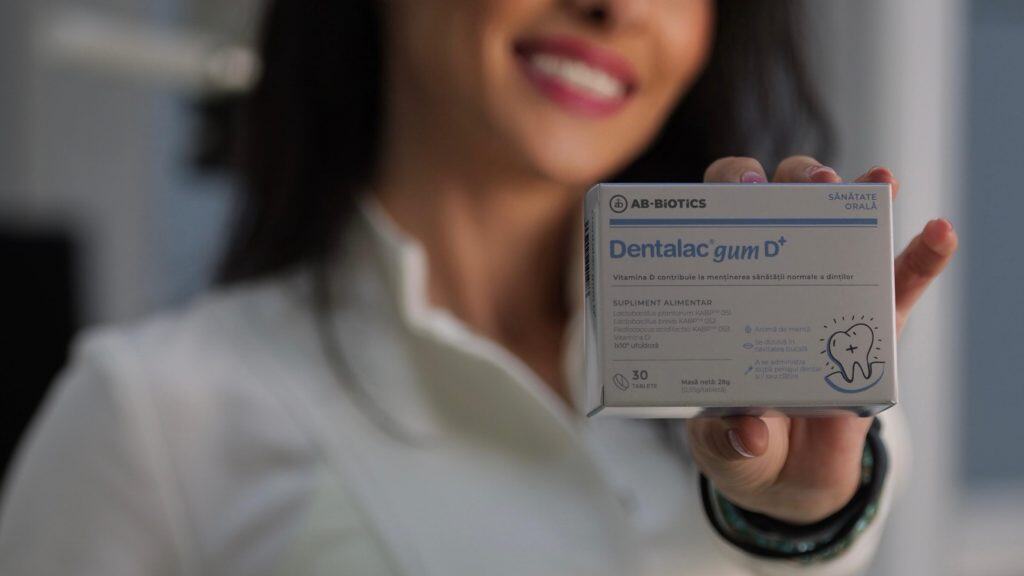
8. Dentalac - Probiotic for restoring the microbiome
- repopulate the flora with beneficial bacteria,
- „occupies the space in the gingival sulcus, so that harmful bacteria cannot attach,
- maintains neutral salivary pH, also contributing to cavity prevention.
Autor: Dr. Nur Saadeddin – Master's in Laser Dentistry Competence S.F.U. Vienna. LSO – AALZ Aachen, Germany. KOL Expert Laser Center. Dentist at Innovation Medical Center-Bucharest and Cluj Smile Society. Over 15 years of clinical experience in Prosthetics, Aesthetic Dentistry, and Laser Periodontology.
Frequently Asked Questions
Biofilm is a layer of bacteria that adheres to teeth and gums. It must be removed to prevent inflammation, bleeding, and the progression of periodontal disease.
For disinfection! Reduces bacteria and lowers the risk of them spreading to the rest of the body.
Because each laser has a different role: the diode disinfects periodontal pockets and reduces bacteria, while the Erbium, Chromium: YSGG laser cleans granulation tissue and calculus, breaks up biofilm, and has a bactericidal effect. Both Erbium, Chromium: YSGG and the diode promote rapid gum healing.
Helps the gum reattach to the tooth and protects the gum sulcus from food debris.
Repopulate the beneficial bacterial flora and prevent harmful bacteria from attaching to the gingival sulcus.
We avoid cuts that can cause bone resorption and additional inflammation.
Initial healing is rapid, and the use of probiotics and maintaining hygiene ensure long-term gum health.
In more advanced cases, 2-3 sessions may be needed at 3-month intervals, depending on the depth of the periodontal pockets and the response to treatment.
In most cases, it is not necessary. We treat locally with a laser, which has a bactericidal effect, thus avoiding an impact on the entire body. After the procedure, we administer probiotics to repopulate the flora with beneficial bacteria.
A neutral pH protects teeth and gums, prevents the development of harmful bacteria, and reduces the risk of cavities and gum inflammation.
Author Dr. Nur Saadeddin
Medical Dentist Expert Laser




















 Romanian
  English