
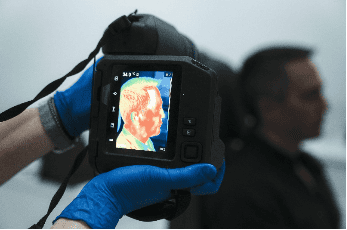
In 2026, dentistry and temporomandibular joint (TMJ) therapy enter a new era: that of Artificial intelligence (AI)-assisted medicine where real-time diagnostics and decision-making processes are supported by advanced algorithms integrated into modern clinical analysis platforms. This allows integration of advanced, analyzed, and correlated objective data in real-time among multiple medical disciplines to build precise and personalized therapeutic plans. At Innovation Medical Center, these protocols are developed and applied in collaboration with international research centers and academic institutions such as AALZ Germany – World Academy for Laser Education in Dentistry and European partner universities, aligning clinical practice with the scientific and technological standards of 2026.
What does AI-assisted medicine mean in dentistry and TMJ/TMD (Temporomandibular Joint)?
AI-assisted medicine uses algorithmic models that can simultaneously process clinical images, functional information, and clinical signs to provide a detailed, immediate, and contextual diagnosis. Unlike traditional systems where data is evaluated separately by each specialist, AI solutions can compare and correlate clinical information, thermographies, ultrasound images, 3D scans, and dynamic occlusion data – all within a single workflow. This type of system will become, in 2026, the cornerstone of complex assessments for conditions such as temporomandibular joint dysfunction, bruxism, or bite imbalances.
How the multidisciplinary ATM treatment is integrated with AI
Treatment of TMJ disorders in 2026 is no longer a set of isolated procedures, but a integrated protocol, in which each specialist brings a piece of the puzzle and where AI helps to synchronize them:
- Assisted Functional Evaluation Thermography, ultrasonography, and bite force analysis interpreted.
- Facial thermography of the masticatory muscles: what heat „sees” before pain appears
Facial thermography allows objective evaluation of masticatory musculature through the analysis of temperature distribution on the face. Overworked or metabolically imbalanced muscles emit more heat, and this is visualized as a color codeWarmer areas appear in shades of red and white, while less active or inhibited areas appear in blue and navy blue. Basically, thermography works as a „thermal map” of muscle activity, highlighting asymmetry between the left and right sides, overload patterns and the relationship between facial musculature and the temporomandibular joint. For the patient, it's a clear and intuitive image of how the jaw muscles function, beyond what can be subjectively felt.
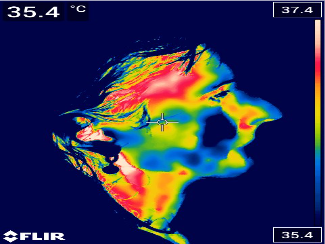
- From Face to Body: Axial Thermography and Its Direct Link to Posture
The evaluation does not stop at the facial level. Through Axial thermography the analysis extends to the entire body, providing a coherent picture of how Posture influences the temporomandibular joint and vice versa. Postural imbalances – at the cervical, dorsal, lumbar, or plantar level – appear as temperature differences that reflect muscle compensation. The body functions as a neuro-musculo-arthrokinetic chain, and a problem in one segment causes adaptations in others. Thus, axial thermography helps identify the relationship between the temporomandibular joint (TMJ), the spine, and foot support, highlighting causes that would otherwise remain hidden. AI-assisted interpretation allows for the correlation of these data into a complete functional overview., essential for effective and sustainable treatments.
- Dynamic TMJ Ultrasound: The joint seen in motion, not just in static images
Ultrasound of the temporomandibular joint performed dynamically provides extremely valuable information in the context of TMJ dysfunctions. Unlike static investigations, ultrasound allows real-time observation of the joint during mouth opening and closing. The position and mobility of the articular disc, the presence of inflammation, the relationship between the condylar head and adjacent structures, as well as potential blockages or trajectory deviations can be evaluated. AI assistance optimizes image visualization and interpretation, aiding in the identification of fine details and objective comparison between the two joints. For the TMJ specialist, this means a accurate functional diagnostic, for the patient, a clear explanation of the cause of the symptoms.
- Bite Force Analysis INNOBYTE and the neurosensory balance of occlusion
Masticatory force analysis is a key element in the evaluation of TMD, and the system INNOBYTE this is currently the only device capable of measuring force of Bite global, as well as differences between part left and right. This evaluation provides information impossible to obtain through X-rays or visual examinations: how pressure is distributed, where overload occurs, and how the neuro-sensory system is involved in bite control. The data obtained is essential for dental treatment planning, adjustment of dental splints or mouthguards, and correlating occlusion with muscular and joint symptoms. Dynamic monitoring allows treatment efficacy verification and its real-time adjustment.
- AI-Assisted Postural Assessment: Upward and Downward Influences in TMJ Dysfunctions
Posture and the temporomandibular joint influence each other mutually, in a continuous dialogue between the musculoskeletal and nervous systems. AI-assisted postural evaluation analyzes these complex relationships, highlighting upward influences (from plantar and spinal support towards ATM) and downward influences (from TMJ imbalances to overall posture). AI-assisted systems can detect Subtle asymmetries, rotations, or offsets care, over time, can lead to chronic pain, balance disorders, or recurrence of TMJ symptoms. Early identification of these patterns allows for prevention and early intervention before the imbalance becomes a structural problem.
- Technology-assisted treatment: the Thor LLLT laser and AI-guided laser acupuncture
In the treatment stage, low-level laser therapy (LLLT) performed with Thor medical laser plays a central role. This technology is supported by numerous studies medical randomized, placebo-controlled, being one of the most validated forms of medical photobiomodulation. The laser is used at both the joint and muscular level, in a completely non-invasive manner. Additionally, the treatment can be complemented with laser acupuncture, a method needle-free, painless, in which AI-assisted systems can identify and select the optimal acupuncture points based on the patient’s functional pattern.
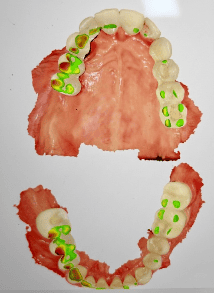
- AI-Assisted Dentistry allows for an objective and detailed evaluation of dental contacts and occlusion, using high-precision 3D scan of the tooth. The data obtained is processed by AI-assisted software that generates functional reports clear insights into how teeth come into contact, distribute pressure, and influence jaw position. Advanced technologies inspired by current standards in state-of-the-art intraoral scanners enable Identifying micro-occlusal imbalances that are not visible during a standard examination. For the patient, this means a more accurate diagnosis and a treatment plan based on measurable data, not on estimates—which is essential in the modern management of TMJ disorders.
- Interdisciplinary collaboration: coordinated treatment plans between a TMJ specialist, dentist, maxillofacial surgeon, ENT specialist, and physical therapist. Thus, treatment is no longer fragmented, but rather a real-time adaptive multidisciplinary plan, supported by both human expertise and the intelligence of modern systems.
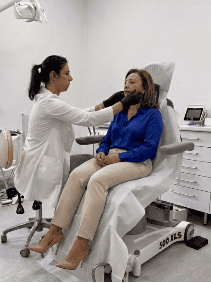
Why this change matters to the patient
The patient benefits from:
- Faster and more accurate diagnosis, validated by both clinical data and functional parameters.
- Personalized therapeutic plan, adjusted in real-time based on progress.
- Reducing diagnostic errors through algorithm-guided interpretation.
- Collaboration between specialists in an integrated workflow, not in a series of separate visits.
FAQ – AI-Assisted Medicine in Dentistry and TMJ
It is the use of artificial intelligence to interpret complex clinical data and supervise treatment plans in real-time.
AI can simultaneously analyze data from thermography, imaging, and functional measurements, providing a complete and objective picture of the patient's condition.
Yes, AI solutions in medicine are validated and integrated as decision support for qualified physicians, not as replacements for them.
In 2026, AI-assisted medicine is changing how temporomandibular joint (TMJ) diagnosis and dental and functional treatment are performed. By integrating real-time data and supporting multidisciplinary decisions, patients benefit from personalized treatments, predictable and efficient — without compromising comfort or safety.
Innovation Medical Center By 2026, it will represent a benchmark in the evaluation and treatment of temporomandibular joint disorders, through the genuine integration of advanced technology-assisted medicine and multidisciplinary collaboration. Our approach is based on the correlation objective functional data, for the use of some Scientifically validated technologies internationally and on the experience of medical teams who work in a coordinated manner, in the same clinical space. For the patient, this means clarity in diagnosis, personalized treatments, and dynamic monitoring of results, in a center that aligns Romanian medical practice with current international standards.
Schedule a comprehensive evaluation
📍 București – www.innovationmedical.ro
📞 0753 666 111
Autor: Dr. Anca Adam, Medic Specialist in Medicina Fizica si de Reabilitare, compartiment recuperare neurologică și disfuncții ATM/TMJ, Expert Acupunctură Laser & Competenta Medicina Traditionala Chineza (Tai Yuan China), Termografie Medicală (Barcelona, Spania) – LSO (Laser Safety Officer) AALZ Aachen Germania.




















 Romanian
  English