
Intense, sudden-onset facial pain, described as an electric shock or a deep burn, is often associated with trigeminal neuralgia. For many patients, the diagnosis comes with a lot of uncertainty, and treatments focus exclusively on pain control. In practice, however, there are situations where trigeminal neuralgia is closely related to temporomandibular joint (TMJ) dysfunction and associated muscular and postural imbalances.
In 2026, the modern approach no longer treats these two problems separately but analyzes them in an integrated, functional, and multidisciplinary manner, a model applied in clinical practice within Innovation Medical Center where the ATM evaluation and the functional neurological evaluation are performed in a coordinated manner, in the same center, based on advanced protocols and scientifically validated technologies.
What is the trigeminal nerve and why is its pain so intense?
The trigeminal nerve is the main sensory nerve of the face and has three major branches:
- orbital ramus,
- maxillary ramus,
- mandibular ramus.
It transmits sensory information from the face, teeth, gums, temporomandibular joint, and masticatory muscles to the brain. When this nerve is irritated, compressed, or functionally overloaded, pain can become extremely intense even if there is no obvious structural damage.
Where does the connection with the temporomandibular joint TMJ appear
The temporomandibular joint is located direct anatomical and functional proximity with the path of the mandibular branch of the trigeminal nerve. TMJ imbalances can cause:
- persistent muscle tension,
- changes in mandibular position,
- repeated overloads on the nervous structures in the area.
This is similar to an electrical cable running through a faulty mechanism: the cable isn't the initial problem, but rather the environment in which it operates.
When can trigeminal neuralgia have a TMJ component
Not all cases of trigeminal neuralgia are related to the TMJ, but there are frequent situations where:
- The pain is unilateral.,
- is associated with jaw locking or popping,
- appears or intensifies with chewing, speaking, or opening the mouth,
- coexist with neck pain, headaches, or tinnitus.
In these cases, a purely neurological evaluation is not sufficient. A Functional assessment of ATM, the masticatory muscles, the suspensory apparatus, and posture.
The Role of AI-Assisted Functional Evaluation
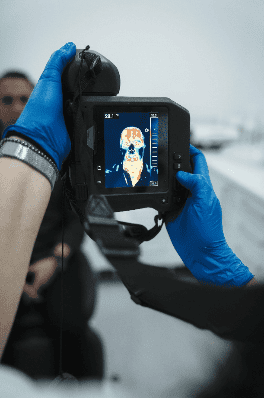
Facial thermography: early signs of neuromuscular overload
Facial thermography allows for the visualization of muscle activity and local metabolism using color coding. Temperature asymmetries in the face may indicate:
- unilateral supraload,
- increased muscular activity in the trigeminal nerve-innervated areas,
- functional areas that support nerve irritation.
For the patient, it is objective proof that the pain has a functional basis.
Dynamic TMJ Ultrasound: The Joint Irritating the Nerve
Ultrasound of the temporomandibular joint (TMJ) performed during movement allows for the observation of the relationship between:
- condyle head,
- Articular disc,
- periarticular structures.
Blockages, misalignments, or uncoordinated movements can generate repeated microtraumas and tensions that are transmitted to the trigeminal nerve. AI assistance helps identify these subtle details and correlate them with the patient's symptomatology.
Bite force analysis: imbalances that perpetuate pain
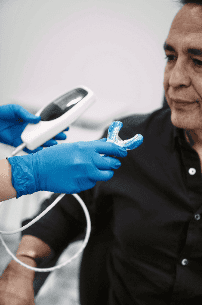
Through the analysis of masticatory force with advanced digital systems like InnoByte, important differences between the left and right sides can be identified. These imbalances can maintain constant stimulation of the trigeminal nerve branches, even in the absence of obvious structural damage.
Data is essential for planning dental treatments and for the correct adaptation of functional dental devices.
Why medication-only treatment is not always sufficient
Analgesic medication can reduce pain, but it does not correct the functional cause when one exists. Without adjustment:
- mandibular position,
- muscle balance,
- cervical posture,
pain can return or become chronic.
Multidisciplinary approach: the key in complex cases
In specialized centers such as Innovation Medical Center trigeminal neuralgia associated with TMJ dysfunction is addressed integrally, through collaboration between:
- Medic specialist ATM,
- Rehabilitation medicine doctor,
- Dentist,
- ENT doctor,
- neurologist (if needed).
This collaboration allows for a clear differentiation between primary neuralgia and neuropathic pain secondary to functional dysfunctions.
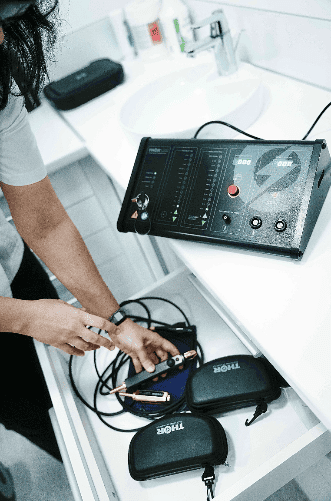
LLLT Thor Laser Therapy and Laser Acupuncture in the Management of Trigeminal Pain
Low-Level Laser Therapy (LLLT), performed with scientifically validated medical systems such as the Thor laser, is used for:
- neuropathic pain modulation,
- support for neuromuscular balance,
- reduction of local hypersensitivity.
Laser acupuncture is a modern, painless, needle-free alternative that is particularly useful in cases of severe pain, where traditional stimulation is difficult to tolerate. AI-assisted guidance can help select the optimal acupoints based on the patient’s functional pattern.
The Link to Posture: Why Pain Isn't Just „In the Front”
Head and cervical spine posture directly influences tension on the cranial nerves. Postural imbalances can maintain trigeminal irritation even if the TMJ is partially corrected. This is why AI-assisted postural evaluation and integrated rehabilitation are essential in preventing relapses.
FAQ - Trigeminal Neuralgia and TMJ
In some cases, yes. Especially when there are associated mandibular and muscular dysfunctions.
When there is a functional component, ATM correction can significantly reduce the intensity and frequency of pain.
Yes, LLLT laser therapy is non-invasive and well-tolerated, being used as part of a scientifically validated complex medical protocol.
Trigeminal neuralgia is not always an isolated nerve problem. In many situations, it is an expression of a complex functional imbalance in which the temporomandibular joint, musculature, and posture play an essential role. A correct evaluation and multidisciplinary treatment can make the difference between temporary pain control and real, long-term relief.
Schedule a comprehensive evaluation
📍 București – www.innovationmedical.ro
📞 0753 666 111
Autor: Dr. Anca Adam, Medic Specialist in Medicina Fizica si de Reabilitare, compartiment recuperare neurologică și disfuncții ATM/TMJ, Expert Acupunctură Laser & Competenta Medicina Traditionala Chineza (Tai Yuan China), Termografie Medicală (Barcelona, Spania) – LSO (Laser Safety Officer) AALZ Aachen Germania.




















 Romanian
  English