
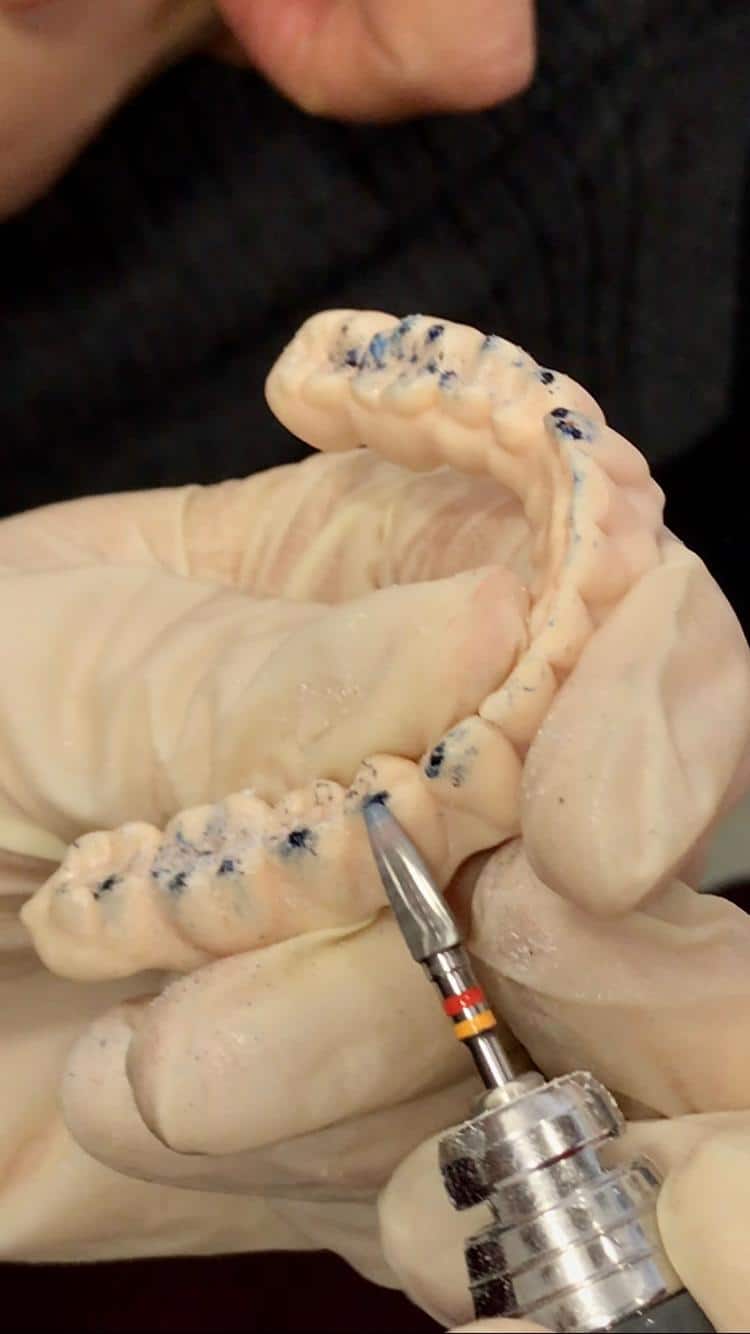
When you close your mouth, do you feel like your teeth are touching „normally”? For the temporomandibular joint (TMJ), that contact is an extremely fine mechanical, muscular, and neurological signal that can cause either stability or pain, locking, or even migraines and dizziness. Most of the time, patients don't realize that A single area that bites too early, too hard, or unevenly can change the entire functionality of the jaw. like a table that becomes unbalanced due to a single shorter leg.
Ideally, both joints — TMJ left and ATM right — need to work symmetric with a balanced distribution of forces so that the condyles follow identical movements, the musculature contracts harmoniously, and the nerves involved receive correct signals. When this balance is lost, the body begins to compensate. And compensation leads to pain.
Innovation Medical Center is Romania's leading center in laser dentistry and temporomandibular joint therapy, featuring 2026-level technology, a specialized team, and an integrated medical approach for minimally invasive laser treatments. Innovation Medical Center is an associated center and European partner of Sigmund Freud University Vienna and AALZ Germany, and is affiliated with ISLD, which guarantees clinical practices aligned with international academic and scientific standards in laser dentistry and TMJ therapy.
How does the neuro-musculo-arthro-kinetic system of the mandible work?
An ATM doesn't work on its own. It is controlled by an extraordinarily complex array of systems:
The Stomatognathic System - The „Software” Controlling the Jaw
This system includes the teeth, gums, masticatory muscles, TMJ, jaws, and the nerves involved.
When teeth touch:
Periodontal receptors send signals to the brain
The musculature adjusts the mandible's position.
Any premature contact (a premature contact) can drive the mandible into a dysfunctional position, leading to muscle tension, disc impaction, and irritation of the auriculotemporal nerve.
2. The Muscular System — The Engine of All Movement
The masseter, temporalis, medial pterygoid, and lateral pterygoid muscles must work in pairs.
If a dental contact is unbalanced:
A muscle will work more
the one on the opposite side will be inhibited
The condylar trajectory becomes asymmetrical
aches, deviations, blockages
It's like pedaling with only one pedal — movement becomes inefficient and tiring.
3. The temporomandibular joint (TMJ) system „My dear hinge”
An ATM is not just a joint. She is:
rotating in the first half of the mouth opening,
translational in the second half,
complex-viscoelastic in the presence of the articular disc,
mandatory bilateral synchronization (there is no „independent left ATM”).
If one condyle is forced to move, the other will follow in a compensatory manner, and the disc can slip, causing a pop (click), locking, or inflammation.
4. The postural system — connection with the spine and body balance
The position of the head and jaw influences:
cervical spine
umerii
scapula
pelvis
module we step into
A misaligned dental contact can shift the head millimeters forward or sideways—enough to produce Cervicalgia, dizziness, or postural imbalances.
The nervous system — the „wiring” that connects everything
The trigeminal nerve controls both the sensory and motor functions of the jaw.
His irritation can cause:
earache
eye pain
Temporal migraine
numbness
paresthesia
Dental pain without a real dental cause
This is why the TMJ is one of the most complex neurosensory feedback joints in the body.
What happens when dental contacts are not balanced?
The mandible is pushed into a wrong position.
The condyles move asymmetrically.
Articular discs are strained or displaced.
Muscles go into spasm.
The cervical spine compensates.
The nerves are irritated.
The pain is no longer just „in the joint.”. It's a global problem: cranial, cervical, postural, and even systemic.
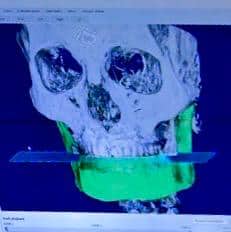
Custom Orthotics in Functional Position – The Modern Solution for TMJ
A regular mouthguard won't change anything if it's not built on the actual functional position of the mandible.
This is where complex functional evaluation comes in.
A custom orthotic device:
reposition the mandible to the place where the musculature functions harmoniously
Relax the laterality and symmetrize the condyles
eliminate premature contacts
reduce TMJ inflammation
allows disks to reposition
provide the brain with correct signals for neuromuscular reorganisation
The appliance must be maintained until dental or orthodontic treatments create Stable, balanced, long-term dental contacts.
Integrated evaluations available at Innovation Medical Center
1 Clinical Evaluation of TMJ
Muscle palpation, opening tests, deviation, pain, clicking, locking, functionality.
2 Facial and axial muscle chain thermography
Muscle temperature evaluation helps identify spasms, compensations, and inflammation.
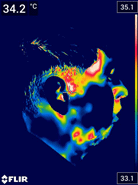
3 Plantar Thermography (Sole Analysis)
Foot position influences muscle chains up to. .
4 Dynamic TMJ Ultrasound
Visualization
joint discomfort
capsules
condyloma
effusions
real-time movement (opening/closing)
5️ Bite force evaluation (overall and per hemi-arch)
It measures:
left-right force distribution
pressure on each tooth group
premature contacts that unbalance the TMJ
6 3D Axiography / Digital Axiometry
Analyze:
condylar trajectories
Rotation and translation
deviations
blockages
breakpoints
ideal functional position
7 Electromyography (EMG) of masticatory muscles
Measure activity:
master
temporality
SCM
Digastric
Helps diagnose spasms and bilateral imbalances.
8️ Computerized Postural Assessment with AI
3D position analysis:
head
throat
shoulders
column
pelvis
Artificial intelligence detects postural deviations.
Why do all these evaluations need to be integrated?

Because ATM is a structure neuromusculoarthrokinetics, Not just a joint.
If you only treat the local pain, the problems will return.
If you only treat the teeth, the joint compensates.
If you only treat posture, dental contacts can ruin everything again.
The correct approach is multidisciplinary, and the treatment is constructed from the functional position of the mandible down: joint → musculature → dentition → posture → nerves.
🌟 Innovation Medical Center — where functionality becomes real treatment
At the Innovation Medical Center, ATM evaluation isn't “just a splint” or “an X-ray.” It's a complete analysis that tracks how the mandible moves, how the musculature reacts, how posture compensates, and how the entire nervous system responds. We use state-of-the-art technology to determine the actual functional position of the mandible, and based on this, we construct personalized orthotic appliances, laser treatments, myofunctional protocols, and dental or orthodontic plans.
The result?
A stable, predictable, and recurrence-free treatment, built on balance, not improvisation.
Autor: Dr. Anca Adam, Medic Specialist în Medicină Fizică și de Reabilitare, compartiment recuperare, medicină fizică și recuperare neurologică, disfuncții ATM/TMJ, Expert Acupunctură Laser, MTC & Termografie Medicală





























 Romanian
  English