
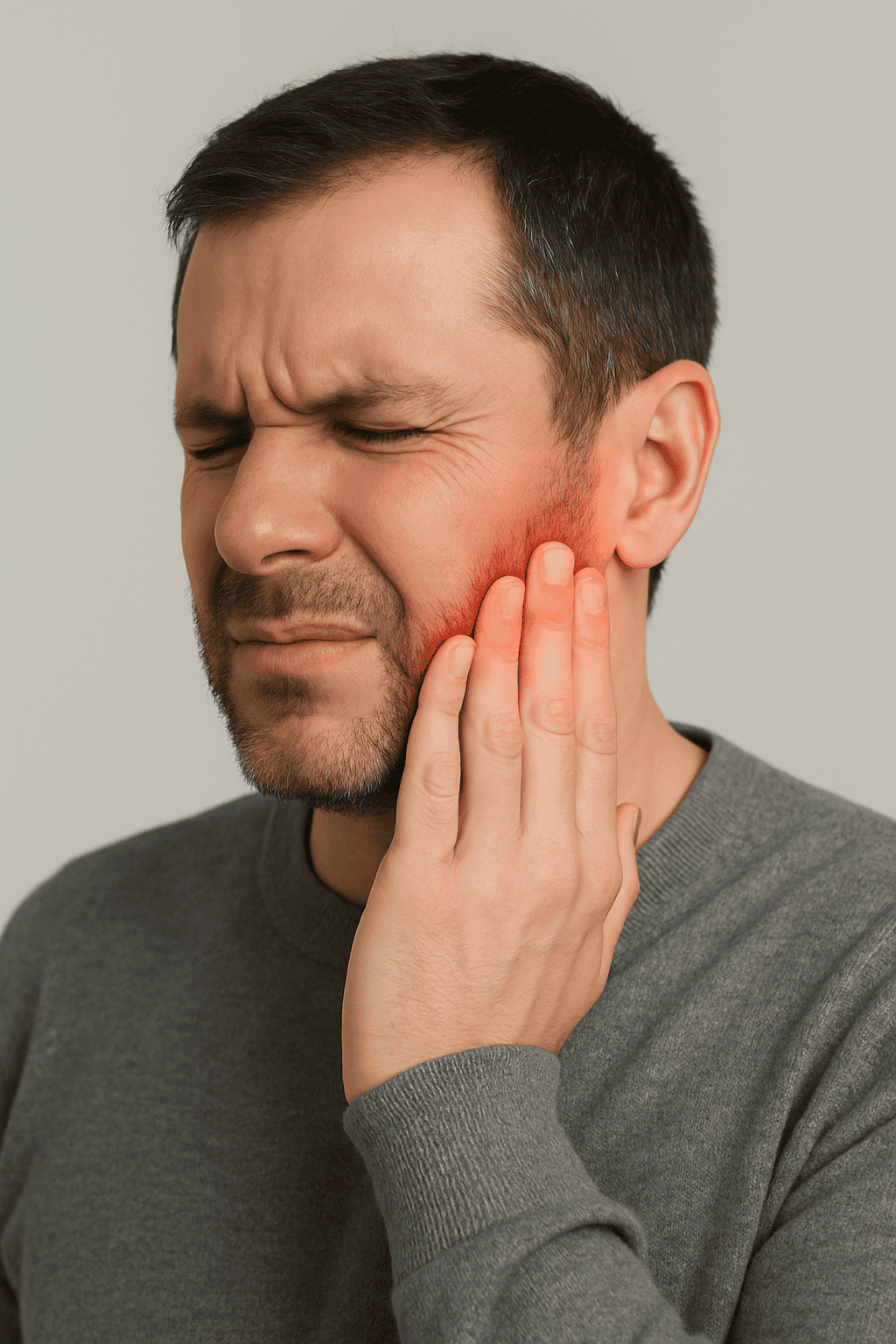
When opening your mouth becomes a problem
Innovation Medical Center applies minimally invasive methods using laser dentistry for TMJ therapy, laser orthodontics, and complete maxillofacial treatments, with technology at the 2026 level, leading in Romania in laser treatments. Innovation Medical Center is an associated center and European partner of Sigmund Freud University Vienna and AALZ Germany, being affiliated with ISLD, which guarantees clinical practices aligned with international academic and scientific standards in laser dentistry and TMJ therapy.
If you've noticed that your mouth doesn't open completely, you feel a click mandible when you chew or have ever had the feeling that The jaw is locked, it's possible to suffer from a common, yet often misunderstood condition: Temporomandibular joint/TMJ dysfunction.
This does not only affect the temporomandibular joint, but influences the entire cranio-cervical biomechanics, causing pain, muscle tension, chewing disorders, and even neurological symptoms.
TMJ Anatomy in Brief
The temporomandibular joint (TMJ) connects the mandible to the temporal bone of the skull. It is a synovial joint with a Articular disc (meniscus-like) that absorbs shock and guides movement.
It's one of the more complex joints from the body
Allows rotational and translational movements
It is influenced by the masticatory muscles
It is extremely sensitive to muscular, postural, or dental imbalances.
What happens when a mandibular click occurs?
Mandibular click este un sunet de tip „poc” sau „clic” pe care îl auzi la deschiderea gurii. It is caused, in most cases, by articular disc displacement:
In the early stage, the disc spontaneously repositions itself at the opening → audible click
In advanced stages, the disc no longer returns locked jaw, with a limit on the opening
What does it mean when your jaw is locked?
Jaw locking can occur suddenly, sometimes after opening your mouth wide (when you laugh, eat, or even when you go to the dentist), and indicates a problem severe functional limitation of the ATM. It can be:
Intermittent: occurs occasionally, accompanied by a feeling of stiffness
PersistentThe jaw isn't opening completely; there's a lateral deviation.
This condition involves inflammation, muscle spasm, possible dislocation of the articular disc, and irritation of the auriculotemporal nerve, a branch of the trigeminal nerve.
Degrees of Severity in TMJ Dysfunction
Stage I – painless clicking
It can be reversible. A mandibular click occurs when opening the mouth, but without any other symptoms.Stage II – Painful click, muscle tension
The articular disc is difficult to reposition, resulting in pain and functional limitations.Stage III – mandibular lock, without click
The disc no longer returns to its normal position. You may feel as though your jaw „won’t snap back into place.”. The mouth opens slightly, at an angle, or with severe pain.
How do we investigate TMJ dysfunction in our clinic?
La Innovation Medical Center, Assessment of TMJ dysfunction It is carried out through a comprehensive, multidisciplinary approach that combines:
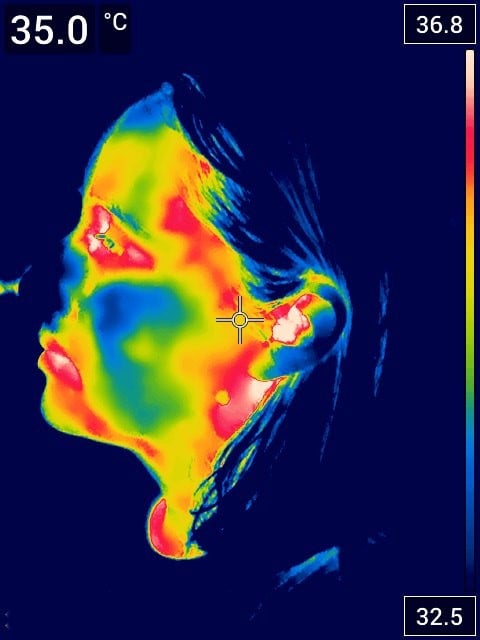
High-precision imaging and functional investigations, ; used to analyze joint structure and muscle function;
Analysis of masticatory force and the balance between the dental arches, for the identification of chronic functional occlusal imbalances;
Detailed intraoral and extraoral evaluation, with functional tests accompanied by analysis of mandibular movements;
Regional and global thermographic scans, useful in detecting inflammatory imbalances and musculoskeletal overloads;
Advanced screening of posture and biomechanical axes, integrated into the global analysis of the muscular chains involved in TMJ dysfunction.
All investigations are carried out within a integrative visions, which emphasizes identifying the real causes of symptoms, not just treating local effects.
What solutions are there?
Treatment of Temporomandibular Joint Dysfunction It is staged and customized. In the case of a click mandible sau locked jaw, solutions vary by stage:
Muscle relaxation
Functional repositioning through guided therapies
Creating a custom fitting mouthguard in the correct functional position
Rebalancing through laser, postural, and occlusal therapies
Where can you turn?
The Innovation Medical Center, our team approaches each patient with Temporomandibular joint dysfunction in a complete protocol: from muscular and postural evaluation, to functional guidance for the splint. We use modern technologies and state-of-the-art tools to precisely understand the cause and tailor treatment without assumptions.
❓ Frequently Asked Questions
Not necessarily serious, but it indicates an imbalance in the TMJ's functioning. Can evolve into locked jaw if it is not corrected.
It can lead to joint locking, inflammation, headaches, neuralgias, or even facial asymmetry. It's not just a dental problem.
Signs include click mandible, facial fatigue, difficulty opening the mouth, neck and shoulder tension, frequent headaches.
Standard gutta does not respect the functional position of the ATM and can worsen symptoms. A custom mouthguard is needed.
It depends on the stage of the illness, but initial improvements often appear after a few functional therapy sessions, especially when the treatment is well-managed.
Conclusion
At Innovation Medical Center, we believe that temporomandibular joint health is essential for the overall balance of the body. That's why we approach each case with care, advanced technology and an integrative vision, to identify the actual source of discomfort and provide personalized solutions. If you experience pain when chewing, clicking, joint noises, or related symptoms like headaches, facial tension or disorders posture, or a complete evaluation can bring you closer to well-being by being the first step towards complex and sustainable treatment. TMJ dysfunction can be managed effectively when it is correctly understood. Schedule a consultation and find out how we can integrate real solutions into your recovery plan.
Autor: Dr. Anca Adam, Medic Specialist în Medicină Fizică și de Reabilitare, compartiment recuperare, medicină fizică și recuperare neurologică, disfuncții ATM/TMJ, Expert Acupunctură Laser, MTC & Termografie Medicală




















 Romanian
  English